Free shipping on every order · 30-day guarantee · Molded in Orange, California
The Hot Tub Cup Holder.com

Finally, somewhere to put your drink in the hot tub.

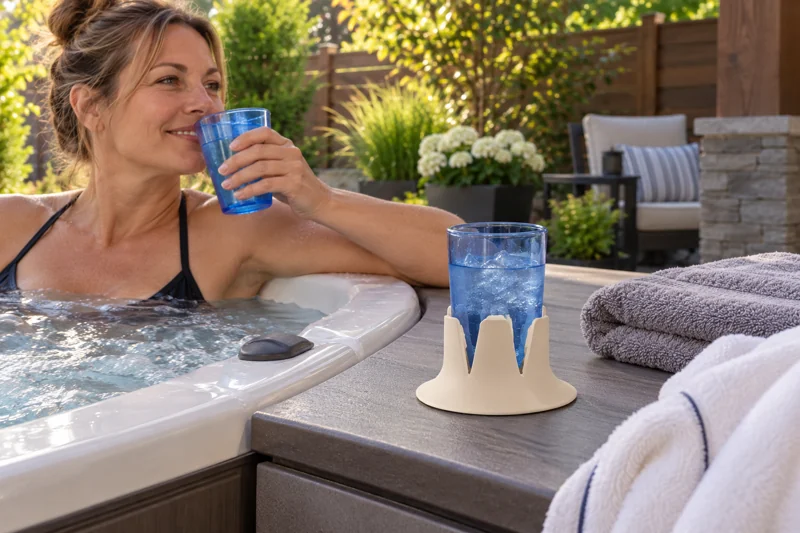
A flexible base that grips your can, your seltzer, or your 40 oz tumbler right at the waterline — the shell's sloped rim, the cabinet's flat edge, or the deck beside an inflatable tub that has no rim to speak of. It doesn't float: drop it in and it sinks straight to the bottom, jets running or not, but a rinse is all it takes to send it right back to work.

See it at steadilabs.com →

Ships free · 30 days to earn a spot on the rim · Molded in small runs in Orange, California

Will your can fit at the waterline? A sticky note settles it — the test is below ↓

Or build your set right here ↓

Left to right: the flexible base empty, then holding a cup, a can, and a large tumbler.
One base, steam included. Empty, then a can, a seltzer, and a 40 oz tumbler — same base, dripping hands and steam included.

Where things stand

The rim was built to drain — and it drains your drink right along with it.

Whether you're stretched out in the lounger or upright in the captain's chair, everything within reach was built to handle chlorinated water, not a can — it drains, it gives, or it moves, and none of that helps a drink stay put.

The shell rim.

A narrow band of acrylic, deliberately contoured and pitched so the pool water runs off it — which means it sheds a can exactly the way it sheds a splash. Reach past it for the topside controls and an elbow finishes the job.

The inflatable tub's soft wall.

Lay-Z-Spa and Intex owners get no rim at all, just an inflated vinyl ring that dips under any lean or climb-in. The makers sell clip-on drink trays for exactly this reason — the wall on its own was never going to hold anything.

The deck, over your shoulder.

Cans lined up on the boards behind your head look like a plan until you need one — a full blind reach over a wall that runs 34 to 37 inches, wet hand groping through rising steam, usually after dark.

The folded cover, on its lifter.

It reads as a shelf. It's actually damp, sloped vinyl behind your shoulder that shifts when it's bumped — and whatever's parked on it is also in the way the moment the cover needs to close.

The float that wanders off.

Turn the jets on and the ring carrying your seltzer is gone inside a minute, pushed clear across the shell by the same current everyone came here to feel.

None of it ends the soak. A hot tub weighs thousands of pounds full — it isn't moving, so every drink has to come to it, and until now that's meant balancing it somewhere wet.

The reruns

You've run this soak before.

Ten minutes in, the moment someone hits the jets

The surface goes from glass to chop in a second — the float carrying your seltzer drifts off across the shell, and the can balanced on the rim starts buzzing against the wet acrylic.

Whenever the last person climbs in

Their entry sends a wave rolling once around the shell that laps right at the waterline where every drink is parked — and every hand on the rim grabs its can at once, on instinct.

A soak in January, running it at 104 with steam rolling off the water

Your can is on the deck behind your head. Getting it means lifting a bare wet arm out of hot water into freezing air, patting around blind through the steam, and dripping straight onto the can you're trying to grip.

A date-night soak, the patio lights off after the kids are down

Two drinks are somewhere on the dark, rounded rim. Reaching for yours by feel, your forearm finds your partner's first — and you both watch it roll into the water you're sitting in.

Round two, halfway through the twenty minutes

The refill run: out of the water, across cold wet decking to the cooler, back over the wall one-handed with a full can — the exact climb that slops water out and drinks in.

What you get

Three reasons it holds through the chop.

01

Grips the slope, and the give.

The wide flexible base conforms to the shell's pitched rim or an inflatable ring's dip instead of needing a flat, dry perch that doesn't exist out here — and the fins grip the can or tumbler itself, so wet acrylic and jet vibration don't matter.

02

Holds what the no-glass rule leaves you.

The can, the seltzer, the water bottle, the 40 oz tumbler. Cans and bottles slide in; tumblers and stemless cups drop through the fins and get held by the bottom inch, whatever the jets are doing underneath.

03

Nothing to clip to a model list.

One piece of matte flexible material — no clip sized to one tub's rim, no pole to level, no tray to unclip before the cover closes. Set it on the rim, the cabinet, or the deck and it's already doing the job.

The desk-drawer test

One sticky note settles it, dry, before you get in.

your cup's base
lands in here

A square sticky note: 3 inches, exactly — the ceiling of what fits, checked dry before you get in.

01
Grab a sticky note.

The classic square is exactly 3 inches on a side — a fact about sticky notes, and it happens to be the ceiling of what fits.

02
Stand your can on it before you get in.

Do it on the counter, dry hands, before the jets go on — wet hands and a sticky note don't mix. Look at the base, not the label; a seltzer can looks slimmer than its actual footprint.

03
Read the note.

Base sits inside the square, it fits. Hangs over the edge, too wide. A small puck lost in the middle — under 2 inches — too narrow.

No spec sheet on the pool deck, no guessing with a dripping arm. One sticky note, checked before the cover comes off, with the can you're actually bringing in.

Sizing it up

The bottom inch decides what rides the rim.

One line covers it: a container base 2 to 3 inches across settles in and holds. Every verdict below follows from that.

There's a floor here too — under 2 inches, a base rattles loose instead of gripping, which is where the champagne flute lands. The handled mug is the honest exception for apres-ski soaks: the base fits fine, but the handle sits exactly where a fin needs to close.

The full fit database — Stanley, Red Bull, Yeti, and 30 more, with sourced base measurements →

The way it works

Made to grip what the rim sheds.

The base spreads across the curve.

Rims and inflatable rings aren't flat — one is pitched to drain, the other gives underfoot. The wide flexible base conforms to that shape instead of resting a narrow bottom on a slope built to slide things off.

The fins grip the can, not the surface.

Flexible fins hold the container by its bottom inch, so the drink is gripped directly rather than depending on the acrylic or vinyl beneath it staying dry and still — useful when everything nearby is wet, sloped, or shaking with the pump.

It settles back through the chop.

A wave rolls through when someone climbs in, the jets kick the surface into chop, an elbow clips it reaching for the topside controls — the base flexes and brings the drink back level instead of riding the bump toward the water.

Nothing clips on, and nothing floats free. No model-specific tray to match to your tub, no pole to level against the cabinet, no ring to unclip before the cover comes down. It sits directly on the rim, the cabinet edge, the cool-down seat, or the deck — on any tub, inflatable or built-in.

The waterline, surface by surface

Nothing near the shell holds still long enough to trust.

The reason drinks lose at a hot tub isn't carelessness — everything within reach is contoured to drain, soft enough to give, or moving with the jets.

The shell rim

Narrow acrylic, contoured and pitched so splash and condensation run off it, and it carries a low buzz of pump vibration whenever the jets are on — a hard surface that was never meant to hold anything still.

The inflatable top ring

Wide but entirely soft PVC that dips under a leaning arm or a body climbing in. There's no firm spot anywhere on it, which is exactly why inflatable-tub makers sell clip-on trays instead of relying on the ring itself.

The cover, folded on its lifter

Vinyl-skinned foam angled behind your head, damp and moving whenever it's touched — a shelf shape with none of a shelf's stillness, and it has to be clear before the cover closes anyway.

The deck below the rim

Concrete or decking sitting 34 to 37 inches under the rim, wet with drip and splash-out, often dim at night — everything set there is set down and then forgotten until the reach.

The float on open water

Light, wind-catching, and pushed by every jet cycle and displacement wave — nothing floating stays where you left it once the pump runs.

What you've tried

What's already sold to fix this, and why it doesn't hold.

Floating drink holders (flamingo and ring floats)

They ride the jet current wherever it pushes them, bob into people, and puncture easily in daily outdoor use; a tall can or tumbler raises the center of gravity enough to tip in the exact chop a hot tub generates.

Pole-mounted swivel side tables

Owners report the same leveling problem across brands — the tray leans away from the tub even off a straight pole — plus small drain holes that let water pool on the surface, and a mount that makes closing the cover awkward.

Clip-on trays for inflatable tubs

Fit is model-specific — one major brand's own tray lists eight-plus incompatible models — and the spring clips have to come off before every cover-on. The cup wells hold two cans fine but run too small for a big bottle or a 40 oz tumbler.

Freestanding side tables and over-the-wall bar trays

Buyer guides and reviews flag the same problems across brands — a fit gamble against a curved shell, warping and weathering outdoors, and trays too large for smaller tubs that eat into the soaking space itself.

A cooler parked next to the tub

It solves supply, not placement — the open can still has nowhere to live once it's cracked, so every refill ends the same way: balanced back on the rim.

Build your set

Pick a pack, give each one a color.

Details

Asked mid-soak, answered here.

Does it float?

No — worth saying plainly: drop it into the tub and it sinks straight to the bottom, jets running or not. Fish it out, rinse it off, and it works exactly the same — a soak or a dunk doesn't bother the material at all. It's built to sit at the waterline, not float on it.

I run an inflatable Lay-Z-Spa or Intex PureSpa — is there even a rim for this to sit on?

The same wide, flexible base that rides a mattress's slopes handles the top ring's give the same way — no flat, rigid perch required. It's just as happy on the cabinet's flat edge, a cooler lid, or the deck beside you, and none of it depends on matching your specific model the way the clip-on trays do.

Will my can or tumbler fit?

Measure the base, not the label or the rim. A base 2 to 3 inches across settles in — a standard can, a slim seltzer, and the 40 oz Stanley all land in that range. The plastic champagne flute is the exception; its foot runs too narrow.

What about glass — a wine glass, a beer bottle?

That call belongs to your spa, not this product: glass is banned around hot tub water almost everywhere, because a break means draining the whole tub. This is built for what the no-glass rule leaves you — cans, plastic tumblers, and steel bottles, which covers most of what actually comes out to the tub anyway.

Do the jets knock it loose?

Movement is the whole design brief. The base flexes with whatever it's sitting on and settles the drink back level when a wave rolls through or the pump kicks on. It resists tipping — not a promise against a direct hard knock, just against the ordinary chop a soak generates.

Does it get in the way of the cover closing?

No — it isn't mounted to anything, so nothing has to be unclipped or moved before the cover comes down the way a clip-on tray or a pole caddy does. Pick it up, set the drink somewhere else, close the cover.

Does it help with staying hydrated during a soak?

Soaking guidance commonly pairs the heat with a water bottle kept within reach and shorter soak windows — advice that only works if there's somewhere for that bottle to actually sit. This gives the water bottle, and whatever else is in rotation, a spot at the waterline instead of leaving it back on the counter.

Does it work away from the tub too — the patio table, the cooler lid?

Yes, at least as well as it works at the waterline. The wide base and the grip on the drink itself are just as useful on a hard, flat surface as they are on a sloped rim or a soft inflatable ring.

How do I clean it?

Rinse it under the tap or run it through the dishwasher — one piece of flexible material, nothing to unclip and nothing to come apart.

Who makes it, and where do I buy one?

It's called the Steadi, molded in small runs in Orange, California by Steadi Labs — veteran-founded and patent pending. Every order ships free from steadilabs.com, with 30 days to change your mind.

The company

Molded a short drive from the rim it'll sit on.

The maker is Steadi Labs, a small veteran-founded company in Orange, California. It's injection molded in small runs, and nothing about it travels far — the mold, the material, and the color runs all sit within about three and a half miles of the shop. The people who make it read hello@steadilabs.com themselves, usually before anyone's turned the jets on for the night.

Thirty days of real soaks.

Run it through a month of soaks. If it doesn't do what this page says — at the rim, in the chop, with your cups — email hello@steadilabs.com and it gets made right. No forms, no fight.

Veteran-founded · Patent pending · Made in Orange, California

The rim finally holds its end of the deal.

Your drink stays right where you set it — the rim, the cabinet edge, the deck within reach — steady through the chop, so the only reach left is for the jet button, not over the wall.

Get yours before the next soak — steadilabs.com →

Checkout is on steadilabs.com — Steadi Labs is the company that makes it.